
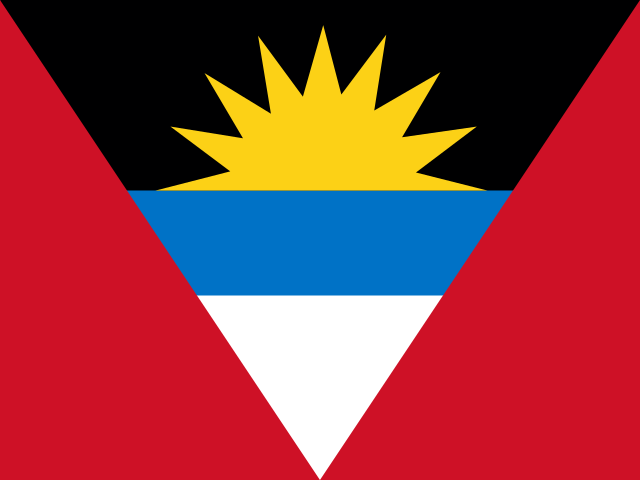
 Antigua and Barbuda
Saint John’s: a Caribbean capital of harbours, memory and island life
Saint John’s faces a bay that linked Antigua with commercial, naval and migratory routes for centuries. The centre contains government buildings, churches, markets, cruise terminals and streets whose activity changes with arriving ships. Beyond the port, residential neighbourhoods, nearby beaches and community spaces reveal a small capital shaped by a much larger Atlantic history.
Clear water and pale sand form an essential part of Antigua and Barbuda’s image, but they do not explain the country alone. Its society was shaped by Indigenous peoples, British colonial rule, African slavery, emancipation and later economic change. These layers appear in forts, buildings, family names, celebrations, food and relationships with the sea.
The harbour and the city
The bay organised the growth of Saint John’s and still shapes its rhythm. Heritage Quay and Redcliffe Quay present the side most closely connected with cruise traffic and shopping, through restored warehouses, stores and spaces designed to receive visitors.
A few streets away, the market and surrounding districts show another urban life. Fruit, vegetables, spices, clothing and everyday goods fill stalls and small businesses, while residents, traders and families use the centre differently from people arriving for a few hours.
For children, the harbour turns the city into a landscape of movement. Ships, cranes, birds, buses and pedestrians show how an island capital depends on maritime connections.
The cathedral and urban landscape
Saint John’s Cathedral dominates part of the centre through its white towers. The building was reconstructed several times after earthquakes and preserves the memory of a city exposed to natural forces that repeatedly shaped its architecture.
Churches, wooden houses and stone buildings respond differently to climate, hurricanes and available materials. Some façades retain galleries and windows designed to improve ventilation.
The mixture of reconstruction, adaptation and repair belongs to the city’s character. Saint John’s is not a perfectly preserved ensemble, but a place that has repeatedly rebuilt its structures.
Museum of Antigua and Barbuda
The Museum of Antigua and Barbuda occupies the former courthouse and contains archaeology, maps, documents and objects from several periods. Its collections connect Indigenous history, European arrival, sugar production and the formation of the modern state.
Everyday objects show how different communities lived. Tools, pottery, maps and documents turn broad historical processes into concrete material.
For families, the museum provides a clear foundation for reading the rest of the island. Forts, plantations, markets and festivals gain new meaning when placed within one connected history.
Slavery, sugar and emancipation
Sugar plantations transformed Antigua’s landscape and depended on the forced labour of enslaved Africans. Mills, former estates and place names retain the trace of a system that created wealth for a few through violence, family separation and social control.
Emancipation in 1834 did not bring immediate equality. Black communities built churches, associations, schools, musical traditions and forms of resistance within a society still marked by deep inequality.
Antigua Carnival is connected with the commemoration of emancipation. Music, costume, dance and parades form a contemporary celebration, while its origins preserve the importance of freedom and collective memory.
Fort James and the harbour entrance
Fort James guards the entrance to the bay and retains cannons, walls and views towards Saint John’s. Its position shows why the harbour mattered to European powers competing for control of the Caribbean.
The fort also reveals how defence, trade and slavery belonged to one colonial system. Ships carried goods, soldiers, enslaved people and information between islands and continents.
For children, cannons, walls and open views make military history visible. For adults, the landscape raises questions about who built, maintained and defended these structures.
Nelson’s Dockyard and English Harbour
In southern Antigua, Nelson’s Dockyard preserves Georgian dock buildings and infrastructure connected with the British navy. Restoration reveals warehouses, workshops and port structures within a protected landscape.
Its history cannot be limited to admirals and ships. Enslaved people and free workers of African origin built, repaired and maintained much of the complex. Their labour was essential to the harbour’s operation.
Shirley Heights overlooks English Harbour and connects defence, landscape and navigation. From above, the hills show how coastal entrances could be watched and ships controlled.
Beaches, reefs and coastal life
Antigua’s coast alternates sheltered bays, open beaches, reefs and mangroves. Each place has different conditions of waves, shade, depth and access.
Reefs and seagrass protect the shore and support many species. Mangroves provide shelter for young fish, birds and other animals.
For families, the coast reveals how the sea belongs to daily life, fishing, food and the economy. Beaches are not only leisure spaces but vulnerable ecosystems and places on which communities depend.
Barbuda and the full scale of the country
Antigua contains most of the population and infrastructure, but the state also includes Barbuda and small Redonda. Barbuda has its own identity, communal relationship with land and a landscape of lagoons, beaches and seabirds.
The Frigate Bird Sanctuary is one of its great natural assets. The birds show the importance of lagoons and coastal ecosystems for breeding and feeding.
The destruction caused by Hurricane Irma opened debate about rebuilding, ownership, displacement and economic futures. These questions show that climate vulnerability affects homes, communities and political choices rather than tourist scenery alone.
Markets and Caribbean flavours
Local food combines African, European and Caribbean ingredients. Fungee, pepperpot, fish, shellfish, tropical fruit and vegetables belong to a table shaped by climate and sea.
Saint John’s market contains fruit, spices, roots, sweets and everyday goods. Antigua black pineapple, mango, tamarind and other fruit bring strong aromas and flavours into local cooking.
Family meals create space for conversation and cultural transmission. Recipes, techniques and celebrations connect generations and show how Atlantic history is also preserved at the table.
Music, carnival and community life
Steelpan, soca, calypso and other rhythms accompany festivals, celebrations and public life. Music is not only entertainment; it also expresses identity, humour, social commentary and memory.
Carnival transforms Saint John’s through parades, costumes, music and community participation. Children and adults share streets and stages, while families maintain traditions passed between generations.
A small capital with many layers
Saint John’s changes according to harbour activity, markets, time of day and season. Streets near cruise terminals may fill quickly, while other districts retain a more local rhythm.
The city remains memorable for the closeness of sea, history and community. Harbour, cathedral, markets, forts and beaches form a capital where Caribbean beauty stands beside a complex memory of slavery, emancipation and island resilience. Its singularity lies in the relationship between landscape, Atlantic history and family life.